

Postpartum Meal Delivery in the U.S.: Confinement Meals and Soup Kits
Updated September 23, 2026.

A postpartum meal delivery service can take shopping, cooking and menu planning off your household's list after a baby arrives. The right service depends on where you live, how much food you want delivered, your budget and who is available to help at home.
If you are searching for “confinement meal kits,” check what the seller actually supplies. Many services deliver prepared meals to heat and eat. Others sell ingredients that still need cooking. A 30-day meal plan and a 30-day soup kit can have very different prices because they provide different amounts of food and do different amounts of work for you.
What do confinement meal services provide?
Chinese and Taiwanese confinement meal services typically build menus around the postpartum practice of zuo yue zi. The providers below offer combinations of cooked dishes, rice or porridge, soups, and sometimes desserts or drinks. Check the exact plan: two meals a day, three meals a day and a soup-focused package are different purchases. JingMommy's plans and YueZi Kitchen's sample menu show that range.
Broader postpartum delivery companies may draw on several food traditions. They can be useful alternatives, but a postpartum label does not necessarily mean a traditional Chinese confinement menu.
U.S. confinement and postpartum meal providers to compare
These are eight providers with published service information, not an exhaustive list or a ranking. Website listings do not confirm availability for your address or due date. Ask for a final quote, delivery schedule and dietary accommodations before booking.
| Provider | Where and how it delivers | Published price example | What to check |
|---|---|---|---|
| JingMommy: fresh meals | Parts of Southern California. Daily delivery in the regular area; some outlying routes receive deliveries every other day. | $2,590 for 30 days, Classic plan, three meals daily. | Confirm your ZIP and any extra delivery charge. Other plans include different amounts of food. Plans, fresh delivery. |
| JingMommy: frozen meals | Weekly shipments to serviceable addresses in the contiguous 48 states. | The four-week Classic program covers 28 days, with three meals daily plus dessert. Request the current price: its plan and FAQ listings differ. | Overnight shipping is listed as included. Allow room for seven day-bags at a time. Frozen Classic, FAQ. |
| YueZi Kitchen / 月膳小廚 | Daily fresh delivery on San Francisco Bay Area routes. | $1,600 for 14 days or $2,900 for 30 days, plus delivery. | Delivery is priced by location. Longer-plan prices differ between its shop and FAQ, so confirm those directly. Shop, FAQ. |
| ShanChu Kitchen / 膳厨月子餐 | Same-day cooking and delivery in the Bay Area. | $1,599 for 14 days or $2,899 for 30 days, plus delivery. | The $100 shopping-cart amount is a deposit, not the package price. Ask for the address-specific delivery charge. Ordering and shipping. |
| Chen Mommy Kitchen / 陳媽媽養生月子餐 | Fresh same-day service on listed New York City-area routes. | Request a meal-plan quote. | Queens and Nassau delivery is listed as free; Manhattan, Brooklyn and New Jersey have additional delivery/toll charges. Its $30 tasting is not a daily meal price. Service, delivery and contact. |
| Hua Foods / 華姐姐 | Daily fresh meals in Greater Atlanta; a chilled delivery service for parts of the Southeast. | Advertised 30-day prices: $4,390 full fresh plan, $3,090 focused fresh plan, or $3,600 chilled plan. | These plans contain different menus. Local fresh delivery has an extra fuel charge; confirm chilled-service ZIPs and fees. Full plan, focused plan, chilled plan, fresh service. |
| Chiyo Postpartum Restore | Chilled postpartum meals across the contiguous U.S., with local and national delivery schedules. | Advertised from $66 per day. | This is a starting rate, not a verified all-inclusive daily total. Confirm the exact food included, plan length and shipping charge. This is a broader postpartum program. Postpartum plans, shipping policy. |
| Restorative Roots, formerly Mama Meals | Frozen postpartum food shipped nationwide, including Alaska and Hawaii according to its FAQ. | $385 for 16 servings, $495 for 24 servings, or $595 for 36 servings. | Servings are not days. Its product/FAQ pages say shipping is included, while its shipping policy says calculated at checkout; confirm the final total. This is a broader postpartum service. 16-serving box, 24-serving box, 36-serving box, FAQ, shipping policy. |
| Welcome Home | Fresh weekly postpartum meals in listed Northeast/DC delivery areas, with local hand-delivery or regional shipping. | Nourishment plans start at $350 for three days or $475 for five days, with breakfast, lunch and dinner on each selected day. | Provider describes family-sized portions for two to three people. Confirm ZIP, fees and current plan price; this is a broader postpartum service. Nourishment plan, delivery FAQ. |
Budget: compare the food and work included
A useful comparison starts with the delivered total:
Package price + delivery charges + applicable taxes + food you still need to buy.
Then check how many people, days and actual meals it covers. Welcome Home describes family-sized portions for two to three people, while JingMommy describes plans for one mother. A dessert, drink or broth may be one item in a package, but it is not another complete meal. Welcome Home plan, JingMommy FAQ.
For example, JingMommy's $2,590 fresh Classic plan works out to $86.33 per program day before any extra charges, with three meals daily. That calculation describes this particular plan; it is not a national average.
Delivery can materially change a local quote. YueZi Kitchen lists San Francisco delivery at $12–$18 per day. If that fee applies on all 30 days, its $2,900 plan becomes $3,260–$3,440 before tax or other additions, or $108.67–$114.67 per day. Confirm the actual address fee rather than assuming this example applies across the Bay Area. YueZi Kitchen's published delivery fees.
By contrast, Restorative Roots' $595 box works out to $16.53 per listed serving, before any unresolved shipping charge. It does not buy 36 days of food. Its stated mix has 12 breakfast servings and 24 lunch/dinner servings. 36-serving package.
A prepared-meal service covers ingredients as well as cooking, portioning, packing and delivery. Compare those services with the shopping, cooking and cleanup your household would otherwise need to handle.
Fresh daily, chilled in batches, or frozen: what fits your home?

Fresh daily delivery can reduce how many days of meals you need to store at once. It also means coordinating regular deliveries and putting uneaten food away promptly. Early-morning arrival is not universal: ShanChu describes a target before 8 a.m., while YueZi gives an approximate 9 a.m.–1 p.m. window. Treat these as provider schedules, not guaranteed arrival times. ShanChu delivery, YueZi delivery.
Chilled batches reduce the number of deliveries but still need refrigerator space. Hua Foods describes five deliveries at six-day intervals for its 30-day chilled plan. Ask which portions should be refrigerated or frozen and check each use-by date; a delivery interval alone does not establish safe storage time. Chiyo also uses chilled deliveries, with frequency depending on the plan. Hua chilled plan, Chiyo shipping.
Frozen batches let you keep meals for later within the product's storage instructions, but freezer capacity becomes part of the purchase. Restorative Roots describes its 36-serving package as 18 containers weighing about 30 pounds. JingMommy's frozen Classic arrives in seven day-bags per weekly shipment. Before ordering, ask for the number and dimensions of containers in each delivery, rather than guessing whether a small freezer can accommodate the box. Restorative Roots package, JingMommy frozen plan.
Arrange for someone to receive and store perishable deliveries. For chilled or frozen shipments, FoodSafety.gov advises that food arrive frozen, partly frozen with ice crystals, or at 40°F/4°C or colder, and be refrigerated or frozen promptly. Meal delivery safety guidance.
Variety: menu choice and ingredient flexibility are different
Prepared meals can offer substantial variety without asking you to cook. YueZi's sample menus include different dishes across the day; Restorative Roots offers preset and build-your-own selections. A curated service such as Chiyo involves less meal selection, although it describes some dietary accommodations. Ask about menu rotation and substitutions if there are foods you dislike or cannot eat. YueZi sample menu, Restorative Roots custom box, Chiyo FAQ.
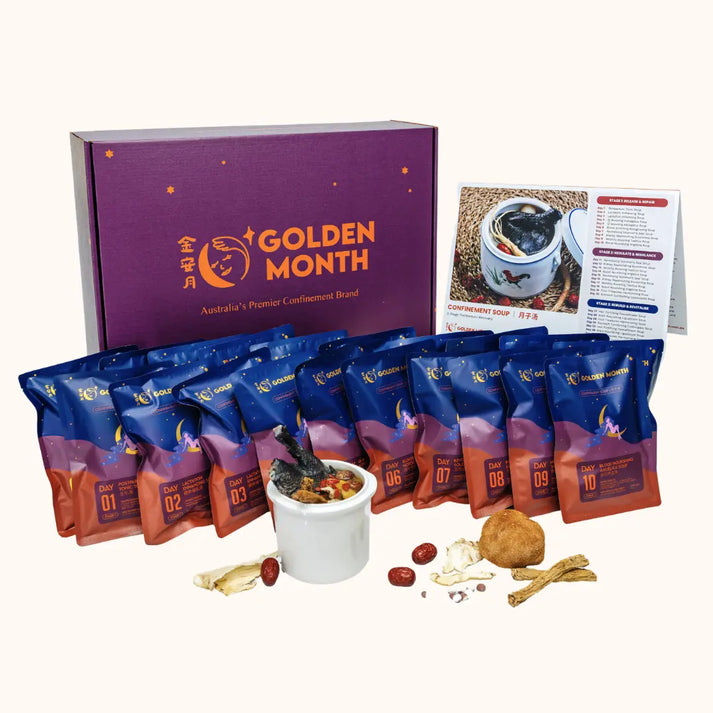
A dried soup kit gives you a different kind of flexibility: you choose the fresh ingredients that go into the pot. Golden Month's instructions recommend meat pairings on individual packs and offer vegetarian preparation with vegetable stock, tofu, mushrooms and vegetables. That can make it easier to fit soup around your household's usual meals. It does not mean every protein suits every blend, or that soup automatically offers more menu variety than a prepared-meal service. Golden Month preparation and ingredient FAQ.
When could a cook-at-home soup kit be a better fit?

Soup kits are worth considering if someone at home can shop and cook, you already have a plan for the rest of the day's meals, and you want to spend less on the kit itself. They may also suit a household that wants more control over fresh ingredients or has limited freezer room.
For a closer comparison of the work involved, read fresh versus dried confinement soups before deciding which format solves your household’s problem.
Our Golden Month kits contain dried ingredients rather than prepared meals. The storage instructions allow the unopened packs to be kept in a cool, dry place away from heat and moisture, with refrigeration suggested as an option. That avoids reserving freezer space for the dry packs. Your meat, other fresh ingredients and finished soup still need appropriate storage. Soup-kit storage instructions.
 10-day soup kitView current price on product page
 20-day soup kitView current price on product page
 30-day soup kitView current price on product page
These are kit-only costs, not the cost of complete daily meals. Add fresh ingredients and the rest of your food budget. Current prices and any offers appear above when available; the linked product pages show the latest details.
Cooking time matters too. Golden Month describes about three minutes of hands-on preparation, but its standard method then simmers for about 90 minutes. The instructions also list a 30-minute pressure-cooker method and four to six hours in a slow cooker. Allow for preparation, bringing the cooker to pressure and pressure release where applicable. A dried kit is not as quick to serve as a prepared meal. Cooking instructions.
Also check what a “soup package” contains before assuming it saves freezer space. Mama Tong, for example, ships prepared frozen soups. That offers a different convenience and storage tradeoff from a dried soup kit.
Which option suits which household?
| Your priority | A practical starting point |
|---|---|
| Nobody has reliable time to cook | Prepared meals. The higher price may be worthwhile because shopping and cooking are handled for you. |
| You want fresh food delivered frequently and live on a suitable route | A local fresh-meal service, with a confirmed receipt window and delivered total. |
| You live beyond local routes and have freezer capacity | A frozen meal program or prepared-food box that serves your ZIP. |
| You have cooking help and want flexibility over fresh ingredients | Dried soup kits alongside your usual meals. Budget for ingredients and cooking time. |
| Your needs change over the month | Consider prepared meals for the busiest period, then home-cooked meals with soup kits if that fits your household. |
There is no single winner. If the main problem is that nobody can cook, buying ingredients in a convenient pack does not solve it. If meals are already being prepared at home, paying for a full delivery program may cover work your household is comfortable doing.
Before committing, ask the provider:
- Does my ZIP qualify, and can delivery start on the date I need?
- What is the final delivered total, and what food is included?
- How much fridge or freezer space will it need, and what are the use-by and reheating instructions?
- Can my dietary needs be accommodated?
- Can the start date change if the baby arrives earlier or later than expected?
If a cook-at-home option fits your plan, choose the duration that suits the meals and help you already have arranged.


